
TPA Claims Processing: Why Indian Hospitals Lose Revenue to Document Bottlenecks — and the Fix
Sibani Sekhar Sahoo · · 17 min read · Healthcare
Share: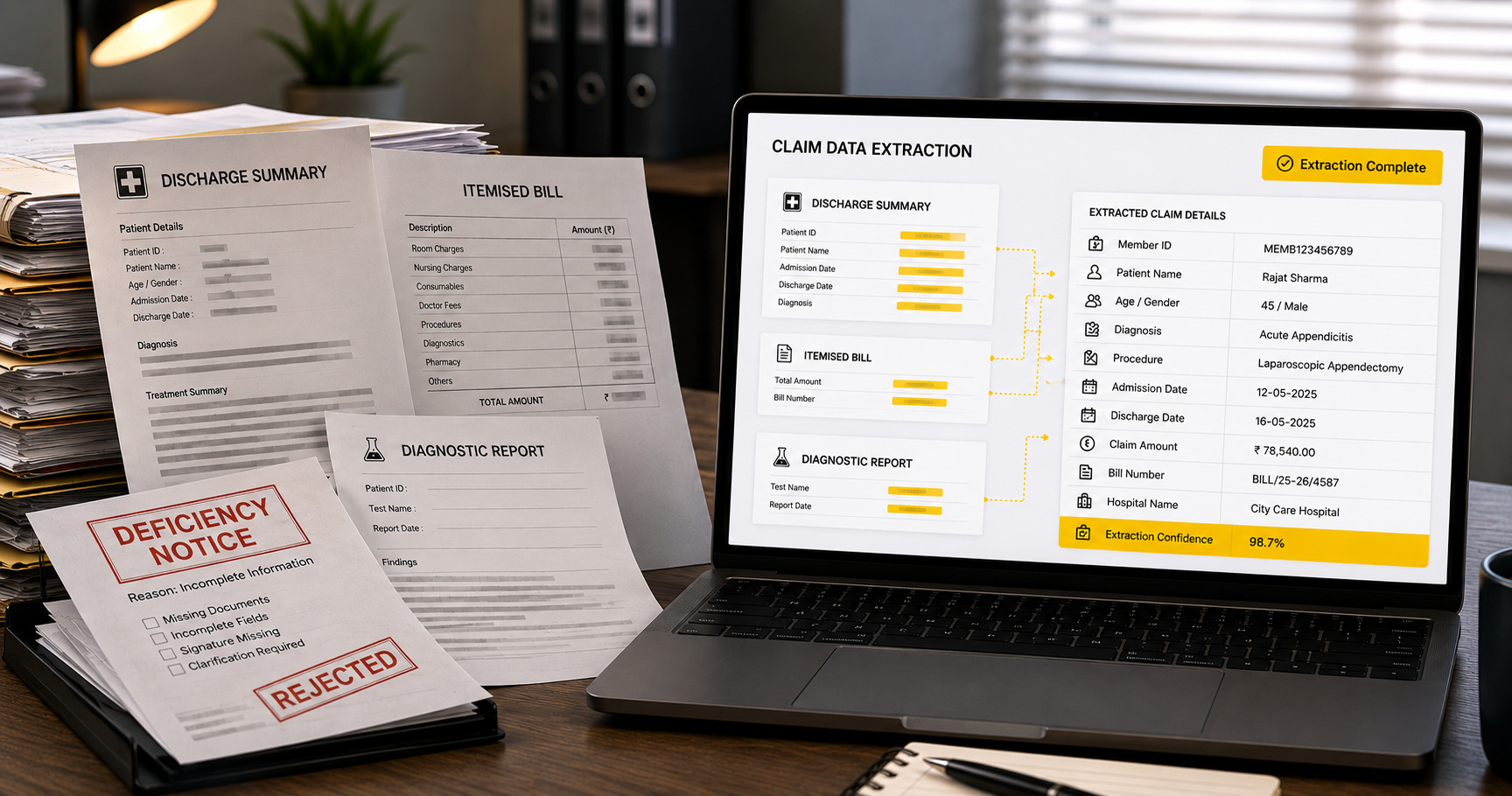
Every hospital administrator knows the feeling. A patient is ready to leave. The family is waiting. The TPA portal is open. And somewhere in a pile of discharge documents, something is missing — or formatted wrong, or scanned at an angle the portal cannot read — and the cashless approval hangs.
That delay is not a minor inconvenience. It is revenue leaving the building.
Indian hospitals collectively process millions of TPA claims every year. The ones that get through cleanly generate working capital. The ones that get stuck — rejected, short-settled, sitting in a resubmission queue for forty-five days — create a cash flow problem that finance teams quietly absorb while clinical leadership remains unaware.
This article breaks down exactly where the revenue goes, why the document handling process is the culprit, and what a practical fix looks like.
The scale of the problem nobody talks about
Ask the CFO of a mid-sized private hospital what percentage of TPA claims come back with deficiencies, and the honest answer is usually somewhere between 25 and 40 percent on first submission. Ask what the average delay on a resubmission cycle is, and it is thirty to sixty days on top of the original settlement timeline.
That is not a process inconvenience. For a hospital doing ₹15 crore a month in insurance billing, a 30 percent deficiency rate with a 45-day average delay means roughly ₹4–5 crore sitting in limbo at any given time. Some of it eventually settles. Some of it gets short-settled because following up costs more than the adjustment. Some of it gets written off entirely.
The reason this does not surface as a strategic issue is that it happens one claim at a time, handled by a billing team that is too busy processing tomorrow's discharges to root-cause yesterday's rejections.
What actually breaks in TPA claims processing
The document requirements for a standard TPA claim sound straightforward in the guidelines. In practice, they collapse under the weight of operational reality.
Fields that exist in documents but cannot be extracted reliably
A TPA claim lives or dies on whether specific data fields can be read, matched, and verified across a set of documents — discharge summary, itemised bill, diagnostic reports, pre-auth letter, policy card. The fields are standard. The problem is that they arrive in formats that resist reliable extraction.
Discharge summaries across Indian hospitals have no single standard layout. Some are free-text narrative dictated by the treating physician. Some are structured templates with fixed fields. Some mix both. A diagnosis field might appear as "Dx: ACS," "Final Diagnosis: Acute Coronary Syndrome," or a raw ICD-10 code — I21.9 — with no descriptor. An extraction process that cannot reconcile these representations will either pull the wrong value or miss the field entirely, and the TPA will flag a deficiency on a document that is complete.
Itemised bills present a different version of the same problem. Indian hospital billing systems produce bills in dozens of formats — some system-generated PDFs with structured tables, some printouts where column positions shift between charge types, some with subtotals embedded mid-page rather than at the footer. A field located at "row 3, column 2" in one bill template sits somewhere entirely different in the next hospital's format. Without genuine document understanding, an extraction tool guesses at structure and produces misaligned data.
Diagnostic reports compound this further. A creatinine value might appear as "1.4 mg/dL," "Creatinine: 1.4," or buried inside a paragraph of interpretive text. The clinical finding the TPA needs to verify the admission basis is in the document. It cannot be located without understanding the document's structure, not just its characters.
When these fields cannot be extracted accurately, the billing team fills them in manually — reading each document, locating the field, transcribing the value into the submission form. Transcription is where errors happen. A member ID copied one digit off, a procedure code entered from the wrong bill row, an admission date pulled from a pre-operative report rather than the discharge summary. These errors are invisible at submission. They become visible when the TPA's system flags a cross-document mismatch and returns the claim.
The format mismatch problem
Every TPA has slightly different document requirements. What Medi Assist accepts, FHPL may reject. The date format one portal expects — DD/MM/YYYY — is different from what another accepts. One TPA needs the discharge summary printed on letterhead; another accepts a system-generated PDF. One requires a specific font size on the bill for scanning legibility; another has no such requirement but flags handwritten entries.
A hospital dealing with twelve different TPAs is dealing with twelve different operational specifications. Billing staff who handle five hundred discharges a month cannot hold all of that in their heads. They guess, they default to a standard format, and they get deficiency notices.
The data accuracy problem
Even when documents are complete and correctly formatted, the data inside them creates problems.
The discharge summary says the patient was admitted for "acute coronary syndrome." The bill codes the procedure as a coronary angiography. The pre-authorisation was issued for "chest pain investigation." The TPA's system finds a mismatch between these three descriptions and flags the claim for manual review.
None of the three descriptions is wrong. They just use different terminology for the same clinical episode — a normal consequence of how hospital documentation flows from emergency admission to discharge. But the TPA's document review process is not clinical; it is textual. Mismatches create delays regardless of clinical validity.
Similarly, arithmetic errors in itemised bills — a unit price multiplied incorrectly, a discount applied to the wrong line, a GST calculation that does not match the header total — are grounds for rejection or short settlement even when the total claim amount is correct.
Unstructured pre-auth documents that the TPA system cannot read
A pre-authorisation request to a TPA is itself a document submission — and it carries the same extraction problems as the final claim package.
The pre-auth request must include the patient's diagnosis, the proposed procedure, the estimated cost, and the policy member ID. These fields feed directly into the TPA's eligibility and coverage logic. When they are present but unreadable — buried in a scanned clinical summary, formatted in a way the TPA portal does not parse, or transcribed incorrectly because the billing staff read the wrong field from the discharge plan — the TPA's system cannot process the request automatically. It goes into a manual queue.
The delay that follows is not the TPA being slow. It is the TPA's reviewer manually deciphering what the submitted documents actually say. For a cashless admission, this is the delay that holds the patient at the billing desk while the clinical team is ready. The clinical information needed for the pre-auth decision is sitting in the hospital's own documents. It simply has not been extracted into a form the TPA can act on.
The same issue affects amendments to pre-auth when the treatment changes during admission — when a procedure added mid-stay needs incremental approval. The updated clinical documentation has to be re-submitted, re-extracted, and re-reviewed. Each cycle is a delay rooted in the same problem: data in documents that cannot be read without a human in the loop.
Where the revenue actually disappears
Document bottlenecks create four distinct types of revenue leakage, each with a different financial character.
Outright rejections
A claim is rejected when the TPA determines it cannot be processed in its current state. The reasons are almost always documentary — missing discharge summary, incorrect member ID, bill and pre-auth amount mismatch, absence of required investigation reports.
Rejected claims require re-submission with the deficiency corrected. This takes time (30–60 days for the resubmission cycle), staff effort (a billing coordinator spends two to four hours correcting and repackaging each rejection), and introduces a risk that the corrected claim gets rejected again on a different deficiency.
Some rejections are never resubmitted. If the claim is small, the cost of following up exceeds the recovery value. It is written off.
Short settlements
Short settlements are quieter and more damaging than outright rejections because they happen without a formal dispute. The TPA pays a portion of the claimed amount — often 70 to 85 percent — and closes the case.
Short settlements typically occur when the TPA cannot verify a specific charge because the supporting documentation is ambiguous or missing. Rather than reject the whole claim, the TPA approves what it can verify and disallows the rest.
Hospitals rarely contest short settlements on small amounts. The dispute process is slow, requires clinical documentation, and the outcome is uncertain. The adjustment goes through, the shortfall is absorbed, and the pattern repeats.
Over the course of a year, short settlements across hundreds of claims represent a significant revenue loss that appears nowhere as a single line item and surfaces only when someone adds up the "disallowances" column.
Delayed settlements caused by extraction errors in the original submission
Every resubmission cycle — triggered by an extraction error in the first submission — extends the settlement timeline by thirty to sixty days. A claim that would settle in the standard fifteen to twenty day window sits for forty-five to seventy-five days because one field was wrong, or one document's data did not match another's, or the bill total as extracted did not agree with the sum of the line items.
The cash flow cost is direct and material. A hospital with ₹10 crore in TPA receivables delayed by an average of 30 extra days — because of extraction errors that pushed claims into resubmission — is carrying the financing cost of ₹10 crore for a month, every month, for a problem that originates not in the insurance process but in how data is read from documents at the point of submission. The root of the delay is not the TPA's settlement speed. It is the quality of the data that arrives at the TPA in the first place.
Compounding re-keying errors across the resubmission cycle
A rejected claim does not simply go back into the queue with one correction. The resubmission requires re-extracting data from the original documents, identifying what was wrong, correcting it, and re-populating the TPA form. This happens manually, under time pressure, by the same billing team that is simultaneously processing new discharges.
Manual re-extraction from the same documents — discharge summary, bill, diagnostic reports — introduces a second round of errors. The field that was copied incorrectly in the first submission may be copied incorrectly again, or a different field may be wrong this time. Deficiency notices on resubmissions are common precisely because correcting one extraction error manually does not fix the underlying process that produced it.
In high-volume hospitals, the resubmission pile grows faster than it is cleared. Claims sit in the queue at various stages of correction — some waiting for a document to be re-scanned, some waiting for a billing code to be clarified with the treating physician, some waiting because the billing coordinator who was handling them is off that day and the next person does not know where in the process they were. Each wait is a data problem in disguise: if the extracted data had been correct and verified at the point of first submission, there would be no queue.
Why traditional OCR does not solve this
The obvious first step most hospitals take when trying to automate their TPA workflow is to buy an OCR tool. Scan the documents, extract the text, submit digitally.
This solves exactly one problem — getting paper into a digital format — and creates a new set of problems that can be worse than the original.
Standard OCR reads characters. It does not understand documents. Given a discharge summary scanned at an angle, it will extract a string of characters. It will not know that "Dx: ACS" means the same thing as "Diagnosis: Acute Coronary Syndrome" or that the ICD-10 code for that condition is I21. It will not notice that the patient's member ID in the document does not match the member ID in the policy database. It will not flag that the total on the bill does not equal the sum of the line items.
It will extract what it sees, pass it on, and leave the validation work — and the error catching — to a human.
Template-based OCR tools, which require training on specific document layouts before they can extract structured data, compound this problem. A hospital dealing with dozens of different insurance policy formats, multiple discharge summary templates across departments, and varied TPA form layouts cannot template-train its way to a working solution. The template breaks every time a document changes format, which in healthcare is constantly.
What TPA claims processing actually needs is not text extraction. It is document understanding — the ability to read a discharge summary and know what the diagnosis is, what procedures were performed, what the clinical outcome was, and whether the billing codes match the clinical narrative. That is not a character recognition problem. It is a comprehension problem.
What intelligent document processing changes
Intelligent document processing (IDP) approaches the TPA claims problem differently. Instead of reading characters, it reads documents — understanding field context, extracting structured data regardless of format, and applying validation logic to catch errors before submission.
The practical difference in a hospital billing workflow looks like this:
Before IDP: A billing coordinator receives the discharge documents from medical records. She manually opens each document, finds the relevant fields, copies the data into the TPA submission form, checks it against the pre-auth letter, and submits. For a complex surgical case, this takes forty-five minutes to an hour. Errors happen because she is doing eight things at once.
After IDP: The discharge documents are uploaded — or flow in automatically from the hospital's document management system. The IDP engine reads the discharge summary and extracts the diagnosis, procedures, admission and discharge dates, and treating physician. It reads the itemised bill and extracts every line item with its code and amount. It reads the diagnostic reports and extracts the key findings. It cross-references the member ID against the policy database. It calculates whether the bill total matches the line item sum. It flags any mismatches — diagnosis-billing code discrepancy, missing investigation report, bill arithmetic error — before the claim is submitted.
The coordinator reviews the extracted data, corrects any flagged items, and submits a complete, validated claim package. The whole process takes ten minutes instead of an hour, and the deficiency rate on first submission drops sharply.
What gets extracted and validated
For a hospital TPA workflow, the documents that need IDP treatment are:
Discharge summary: Diagnosis (text and ICD-10 code), procedure list, admission date, discharge date, treating physician, ward and bed number, follow-up instructions. The IDP engine should reconcile the free-text diagnosis with the ICD-10 code to catch miscoding.
Itemised bill: Every charge line with description, quantity, unit price, total, applicable GST, and the cumulative bill total. The IDP engine should validate that the line item totals match the bill total and that any approved package charges are correctly applied.
Diagnostic reports: Patient name, report date, test name, key findings, reference ranges where applicable, and the reporting physician. The IDP engine should match the patient identity across documents and flag where reports reference conditions or findings not reflected in the discharge summary.
Pre-authorisation letter: Approved amount, approval reference number, valid dates, and any conditions or exclusions. The IDP engine should compare the approved amount against the submitted bill amount and flag where the bill exceeds the pre-auth.
Policy document / e-card: Member ID, policy number, insurer name, TPA name, coverage dates, and sum insured. The IDP engine should validate that the claim falls within the coverage period and that the member ID matches what appears in other documents.
Integration into the TPA submission workflow
IDP is most useful when it sits inside the submission workflow rather than alongside it. The sequence that works in practice:
- Documents are uploaded to the IDP platform at the time of discharge processing — either directly from the hospital's EMR/HIS or via a simple upload interface at the billing desk.
- The IDP engine processes all documents simultaneously, extracting structured data and running validation checks.
- The billing coordinator receives a structured summary of the claim package with any issues flagged for review.
- The coordinator clears the flagged items, confirms the package, and the system formats the output for the specific TPA — their form layout, their date formats, their required document sequence.
- The formatted claim package is submitted to the TPA portal via API or uploaded as a formatted PDF bundle, depending on the TPA's technical capability.
The result is a first-submission quality that is significantly higher than what manual preparation produces — and a document preparation time that is a fraction of the manual effort.
The specific gains hospitals see
The outcomes that matter in TPA claims processing are measurable, and hospitals that have implemented IDP in their billing workflows report consistent patterns.
First-submission acceptance rate improves from 60–70 percent to 85–95 percent. The bulk of deficiency notices disappear because the documents are validated before submission rather than after rejection.
Claim cycle time drops. A claim that previously took 30–45 days because of one or two resubmission cycles now settles in the standard 15–20 day window. Cash flow improves in proportion.
Short settlement frequency decreases because every charge in the bill is supported by a correctly formatted, linked document. The TPA cannot disallow what it can verify.
Staff time on TPA claims reduces significantly. Billing coordinators who previously spent 40–50 percent of their time on deficiency management and follow-up redirect that time to prevention — reviewing high-value claims before submission rather than correcting rejections after.
Write-off rates fall because fewer claims are abandoned due to follow-up cost exceeding recovery value. The claims that were being written off are now being submitted cleanly the first time.
What implementation looks like in practice
A hospital implementing IDP for TPA claims does not need to replace its existing systems. The IDP platform sits between the document sources (EMR, HIS, scan stations) and the submission target (TPA portal or billing team).
The practical implementation path for a 200–500 bed hospital typically runs as follows:
Phase 1 — Document standardisation (weeks 1–2): Map every document type currently in the discharge package to the IDP document models. Identify which documents come from which systems, in which formats. Define the validation rules — what a complete claim looks like for each TPA the hospital works with.
Phase 2 — Pilot on a single TPA (weeks 3–6): Run the IDP workflow for one TPA with parallel manual processing. Compare the first-submission acceptance rate, the extraction accuracy, and the time taken. Tune the validation rules based on actual rejection patterns.
Phase 3 — Full rollout (weeks 7–12): Extend to all TPAs. Train the billing team on the new workflow. Establish a feedback loop from rejections back into the validation rules.
Phase 4 — Ongoing optimisation: Use the rejection data to identify persistent document quality issues upstream — in medical records, in the laboratory reporting process, or in the billing coding system — and fix them at the source.
The total implementation effort for a hospital with an existing HIS and a willing billing team is typically two to three months from start to a fully operational workflow.
The document problem is solvable
TPA claims processing in Indian hospitals is broken at the document layer, not the clinical layer. The care was delivered. The charges are legitimate. The policy covers the admission. Revenue is being lost to paperwork — to incomplete packages, to format mismatches, to arithmetic errors that could have been caught in thirty seconds by a system that knows what to look for.
Intelligent document processing does not require a hospital to change how it delivers care, how it structures its billing, or how it negotiates with insurers. It changes how documents are prepared, validated, and submitted — the administrative layer that sits between the care delivered and the payment received.
The revenue that hospitals lose to document bottlenecks is recoverable. The process is fixable. The technology to fix it exists and works at scale.
The only thing required is the decision to stop treating deficiency management as an acceptable operational norm.
DocXtract is an AI-powered intelligent document processing platform built for Indian businesses. It extracts structured data from hospital discharge summaries, itemised bills, diagnostic reports, insurance policy documents, and TPA claim forms — with 98%+ field-level accuracy, no templates required. See it work on your own documents at docxtract.io.