
What Your Manual AP Process Costs Every Month
Sibani Sekhar Sahoo · · 10 min read · IDP
Share: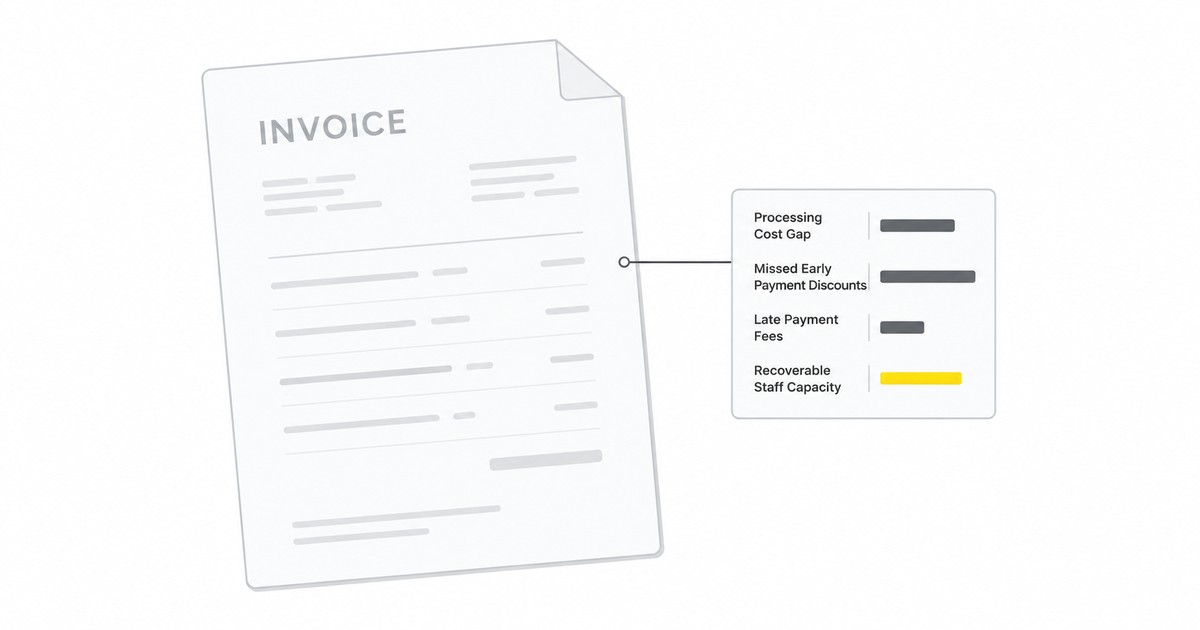
Every month your AP team processes invoices manually, four costs leave your business quietly. Not as a line item on a P&L. As the gap between what you pay and what you could have paid, between what your team does and what they could be doing.
Most finance leaders measure the cost of AP automation. Almost none measure the cost of not automating. That is the calculation worth doing first.
This is that calculation.
The four components of AP opportunity cost
Manual AP cost is not one number. It is four numbers that most finance teams have never added up at the same time.

Component 1: The processing cost gap
This is the most straightforward number, and usually the most underestimated.
For Indian enterprises, the fully-loaded cost of processing a single invoice manually sits between Rs. 150 and Rs. 300, depending on the complexity of the document mix and the number of formats in play (MYND Integrated Solutions, 2024). That figure includes AP staff time, supervisory overhead, error correction cycles, and the technology running underneath the process.
Automated processing of the same invoice costs under Rs. 50.
At 3,000 invoices per month, that gap is Rs. 3 lakh to Rs. 7.5 lakh. Every month. Before any other cost category is counted.
The gap is not theoretical. It is the difference between what you pay a person to read and key a document and what it costs to process that same document without one.
The honest caveat: the Rs. 150-300 range assumes a real production environment with genuine format variety. If your vendor base is small and uniform, your per-invoice cost may be at the lower end. If you have regional suppliers, diverse formats, scanned documents and mobile photos in the mix, you are likely at the upper end and possibly above it.
Component 2: Missed early payment discounts
Most suppliers offer a 1 to 2 percent discount if payment arrives within 10 days of invoice receipt. It sounds small. At scale, it is not.
Manual AP teams capture these discounts on roughly 20 percent of eligible invoices. The reason is structural: the processing cycle is simply too slow. By the time an invoice has been received, keyed, matched, queued for approval, and approved, the 10-day window is frequently closed. The remaining 80 percent of discount opportunities expire.
Automated teams capture discounts on 65 to 80 percent of eligible invoices, because processing happens in hours rather than days.
On a Rs. 25,000 average invoice with a 2 percent early payment discount, each captured discount is worth Rs. 500. If 60 percent of your invoice base carries discount terms, and you are currently capturing 20 percent of them, the calculation looks like this:
At 3,000 invoices per month, 1,800 carry discount terms. You currently capture 360 of them. An automated system captures 1,170 to 1,440 of them. That difference of 810 to 1,080 discounts, at Rs. 500 each, is Rs. 4 lakh to Rs. 5.4 lakh per month in captured value you are currently leaving on the table.
Component 3: Late payment fees and the vendor relationship you are quietly damaging
Late payment fees are the only AP cost category most finance teams actually track, because they show up on statements. They are also the smallest part of the real cost of paying late.
The average cycle time in a manual AP process is 14.6 days from receipt to payment (Levvel Research and Ardent Partners, 2025). Automated processes run at 3 to 5 days. For invoices with Net 30 terms, a 14.6-day cycle leaves very little margin. A batch of invoices arriving during a peak period, a key approver on leave, or a document exception that needs resolution pushes payment past the due date with no warning and no escalation.
Late payment fees are typically 1.5 to 2 percent per month on the outstanding amount. On a Rs. 5 crore monthly payables base, even a 3 percent late-payment rate is Rs. 3 lakh per month in penalties. That number is real and trackable.
What does not appear on any statement is what happens to the vendor relationship over time.
The first late payment gets a polite reminder. The second gets a tighter follow-up. By the fourth or fifth, the vendor's internal credit team has flagged your account. What changes is not always visible immediately. A preferred material gets allocated elsewhere when supply is tight. A request for extended credit terms gets declined. A pricing negotiation that should have gone in your favour does not, because the account manager knows your payment history and has less reason to stretch. A strategic supplier begins quietly diversifying away from you, not because of any formal decision, but because reliable customers are lower-risk customers and they prefer to serve them.
None of this appears as a line item. But the cumulative commercial cost of being known in your supply base as a slow payer is real, and it compounds in the same direction as the fees: downward.
A vendor who is paid reliably will negotiate differently than one who is not. The discount they offer, the flexibility they extend, the priority they give your orders in a crunch, all of that is vendor goodwill, and goodwill is built or eroded one payment cycle at a time.
There is also a less-discussed consequence specific to India. In industries where supplier relationships are long-standing and relationship-driven, a reputation for slow payment travels. Vendors talk to each other. In logistics, manufacturing, and BFSI supply chains especially, the informal signal that a buyer is difficult to get paid by affects who is willing to quote, who provides the best terms, and who prioritises your orders when capacity is constrained.
For the purposes of the opportunity cost formula, use your tracked late fees as the floor for Component C. The real cost is higher. How much higher depends on how long the slow-payment pattern has been running and which suppliers are affected.
Component 4: The capacity cost
This is the one most finance leaders intuitively understand but rarely quantify.
In a manual AP process, roughly 55 percent of an AP team member's time goes to logistics: locating invoices, keying data, handling exceptions, chasing approvals. The work that actually requires judgment, vendor analysis, payment term negotiation, anomaly investigation, cash flow planning, accounts for less than half the day.
The capacity cost is not the salary of the people doing the data entry. It is the salary of the people doing the data entry instead of the analysis work that creates value. A team of five AP staff earning Rs. 8 lakh per year each, spending 55 percent of their time on document logistics, represents Rs. 22 lakh per year of analytical capacity being consumed by keying.
That capacity does not disappear when you automate. It redeems. It becomes available for work that compounds: supplier negotiations, working capital analysis, duplicate-vendor audits, early payment strategy. That is the recoverable cost that converts directly to value rather than simply stopping.
Running the calculation for your own numbers
Four inputs. One monthly figure.
| Component | What to calculate |
|---|---|
| A. Processing cost gap | Monthly invoices x (Rs. 200 manual cost − Rs. 50 automated cost) |
| B. Missed early payment discounts | Eligible invoices x avg invoice value x 2% discount x 60% uncaptured |
| C. Late fees + vendor relationship cost | Late fees from AP records / 12 (floor only; real cost includes eroded trust and lost commercial terms) |
| D. Capacity cost | AP team monthly salary total x 55% (share of time on document logistics) |
| Total monthly opportunity cost | A + B + C + D |
For a team processing 3,000 invoices per month, this typically lands at Rs. 10-20 lakh per month, or Rs. 1.2-2.4 crore per year. Use Rs. 200 as a conservative mid-range manual cost if you do not have your own per-invoice cost tracked (benchmarks: MYND Integrated Solutions, 2024; Levvel Research, 2025).
A worked example
A manufacturing company processes 2,500 invoices per month across 180 active vendors, with a five-person AP team earning an average of Rs. 7.5 lakh per year each. Average invoice value is Rs. 22,000. Roughly 60 percent of invoices carry early payment discount terms of 2 percent.
Component A: 2,500 invoices x Rs. 150 (conservative processing cost gap) = Rs. 3,75,000 per month.
Component B: 1,500 eligible invoices x Rs. 22,000 x 2% discount x 60% uncaptured = Rs. 3,96,000 per month.
Component C: From records, Rs. 84,000 in late fees over the past 12 months = Rs. 7,000 per month.
Component D: 5 staff x Rs. 62,500 monthly salary x 55% on logistics = Rs. 1,71,875 per month.
Total monthly opportunity cost: Rs. 9,49,875. Call it Rs. 9.5 lakh per month, Rs. 1.14 crore per year.
That is not the cost of buying an automation solution. That is the cost of not buying one, already leaving the business, every month, right now.
What this number is not
One honest admission before the close.
The four-component model above does not capture every cost, and some of the inputs require estimates. If you do not track late fees separately, Component C will be approximate. If your AP team handles functions beyond invoice processing, Component D may overstate the document logistics share.
The model also does not capture the audit and compliance exposure of a manual process. Missed duplicate payments, incorrect tax codes, incomplete audit trails, the cost of these surfaces in year-end reconciliation and, occasionally, in regulatory reviews. They are real costs, but harder to put a monthly figure on.
Use the four-component model as a floor, not a ceiling. The actual opportunity cost in most organisations is higher than the formula produces, not lower.
Frequently asked questions
What is the opportunity cost of manual AP processing?
Opportunity cost in manual AP has four components. The first is the direct processing cost gap, typically Rs. 150-300 per invoice manually versus under Rs. 50 automated. The second is missed early payment discounts, where manual teams capture only 20% of available discounts versus 65-80% with automation. The third is late payment fees plus the vendor relationship erosion that slow payment causes over time, including tighter credit terms, deprioritised service, and lost negotiating leverage. The fourth is the capacity cost of skilled staff spending most of their time on data entry rather than judgment work. Together these typically exceed Rs. 10 lakh per month for a team processing 3,000 invoices.
How do you calculate the real cost of manual invoice processing?
Start with your monthly invoice volume multiplied by your cost per invoice. If you do not know your per-invoice cost, Rs. 200 is a reasonable mid-range estimate for an Indian enterprise handling a mixed format base (MYND Integrated Solutions, 2024). Add missed early payment discounts, which are 1-2% of invoice value on invoices processed too slowly to capture the discount window. Add any late payment fees from the past 12 months. Add the implicit cost of AP staff time spent on data entry rather than analysis.
How much can AP automation reduce invoice processing cost?
Industry benchmarks show manual invoice processing costs Rs. 150-300 per invoice for Indian enterprises (MYND Integrated Solutions, 2024). Automation typically brings this under Rs. 50, a reduction of 70-80%. At 3,000 invoices per month, that difference alone is Rs. 45-90 lakh annually before early payment discounts or error savings are counted.
What is a realistic early payment discount capture rate for a manual AP team?
Manual AP teams capture early payment discounts on around 20% of eligible invoices on average, because the processing cycle is too slow to meet the discount window, which is typically 10 days. Automated teams raise this to 65-80%. On a Rs. 25,000 average invoice with a 2% early payment discount, that improvement is worth Rs. 500 per invoice captured.
How long does it take to see ROI from AP automation?
Most mid-sized organisations processing 1,000 or more invoices per month see payback on AP automation within three to six months. The primary drivers are the per-invoice cost reduction and early payment discount capture, both of which begin accruing from the first month of operation. Organisations that also track error remediation savings and staff time redirection typically find the total return is higher than the initial estimate.