
How to Evaluate an IDP Platform: 5 Questions Every Enterprise Should Ask
Sibani Sekhar Sahoo · · 12 min read · IDP
Share: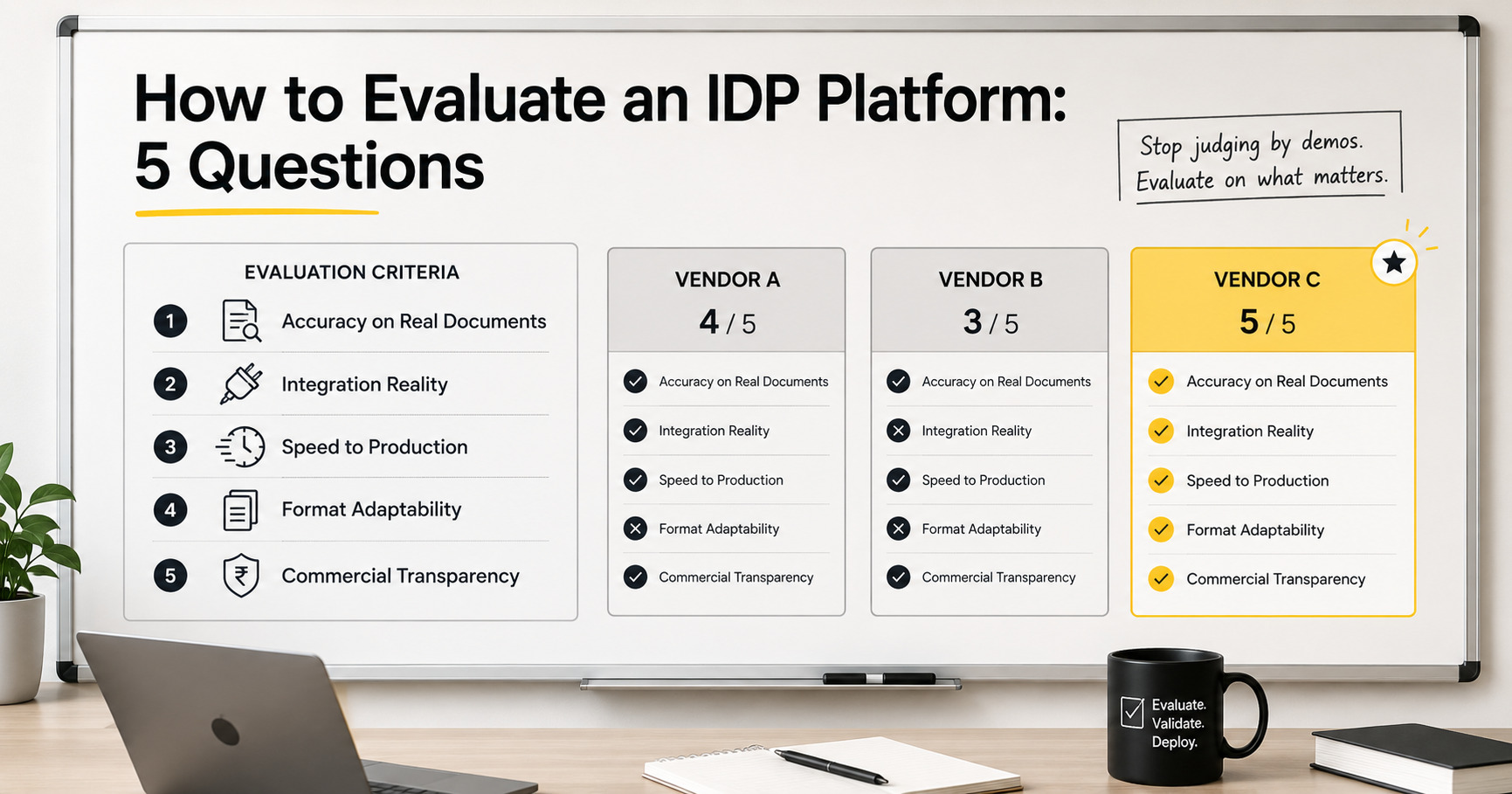
The IDP market has matured quickly. Dozens of vendors now claim AI-powered document extraction, with benchmark charts and accuracy numbers that look compelling on a slide.
The problem: most of those numbers come from curated test sets. Clean documents, known formats, controlled conditions. Deployed against your actual documents (the scanned NACH mandates, multi-page loan files, supplier invoices in forty different layouts), many platforms reveal their limits within weeks.
Choosing wrong is not quickly recoverable. Implementation takes months. Integration is bespoke. Switching cost is high. The evaluation you run before signing matters more than almost any other step in the procurement process.
These five questions cut through vendor positioning and get to production reality.
1. What is your accuracy on documents your model has never seen before?
Every vendor will show you accuracy numbers. The right follow-up is: where did those numbers come from? If the answer is "our benchmark test set," the model was tested on data it was prepared for.
Production reality is different. A new supplier arrives with a layout the system has never encountered. A regulatory update adds a mandatory field. The number you need is field-level accuracy on out-of-distribution documents: formats the model saw for the first time, with no prior training or template configuration.
The gap between 80% and 98% is not a footnote. It determines whether your AP team shrinks by 80% or stays the same size correcting extraction errors all day.
2. What does integration actually look like, and who does the work?
Document extraction is only useful if extracted data flows into the systems that need it. An IDP platform that delivers structured JSON to a folder is not integrated. It has moved the manual work one step downstream. Someone still has to copy data into SAP, Finacle, or whatever system of record your business runs on.
Integration is where most IDP projects discover their real cost. The demo showed a clean flow from document to database. The actual implementation revealed a six-month custom API project, an IT resource allocation, and change management nobody budgeted for.
3. How long before the first real document goes through in production?
This is the most useful single metric in any IDP evaluation: how many days from contract signature to the first real document processed in your live environment, with no human intervention.
Legacy platforms were designed in an era when document processing was a specialist IT project. Even modern AI platforms often carry that legacy in their implementation methodology. The cost of deployment time is almost always underweighted in the business case: months of IT capacity, management attention, and headcount, before a single piece of ROI arrives.
A deployment that takes three months to go live consumes three months of IT capacity and management attention before delivering a single piece of ROI. That cost never appears in the vendor's business case.
4. What happens when something goes wrong, and who owns the outcome?
Every vendor will tell you their platform works. The more revealing question is what the relationship looks like when it does not. A document type that was extracting at 97% drops to 80% after a supplier changes their invoice layout. A system update breaks a field mapping. A new document sub-type starts flowing through that the model has not seen before.
For a process as operationally critical as document extraction, where a backlog of unprocessed invoices or KYC files has real business consequences, that is not good enough. You need to understand, before you sign, who owns the outcome when performance degrades and how quickly the loop closes.
5. Can we try the platform on our own documents before we commit to anything?
Before any commercial conversation, before any contract, before any scoping exercise: ask the vendor if you can send a batch of your real production documents and see what the platform actually does with them.
A vendor confident in production performance will say yes immediately. A vendor who steers you toward a demo on their curated examples, or asks you to wait until after an onboarding setup, is telling you something important about what happens when their platform meets your real documents.
You are not asking for a commitment on either side. You are asking to see evidence. Send a representative batch, a mix of your highest-volume document type, including some tricky ones: unusual layouts, scanned copies, documents with handwritten fields.
You do not need to commit to a pilot, a proof of concept, or a contract to find out whether a platform can read your documents. How a vendor responds to this request tells you a great deal.
The evaluation scorecard
Run each vendor through this before the final decision.
One question worth asking yourself first
Before any vendor evaluation, be clear on what you are actually solving for. Not "we need IDP" but: which specific document workflow is costing us the most right now, and what does good look like for that workflow in 90 days?
The most successful IDP deployments start with a single use case (one document type, one business process, one target system) and demonstrate measurable results before expanding. The vendors most willing to take that approach, and most willing to be measured against your baseline from day one, are the vendors most likely to deliver in production.
Start with one document type. Measure everything. Expand only when the first use case has a number you can stand behind in a board meeting.
Frequently asked questions
Ask the vendor to demonstrate on your documents, not theirs, before any contract or commercial conversation. Send a representative batch that includes your highest-volume document types, your trickiest formats, and a few scanned or handwritten examples. Any platform worth evaluating should return extraction results within days, not weeks.
Look at field-level accuracy on the fields that matter most to your process, how it handles documents it clearly has not been trained on, and what it flags for human review versus what it passes through with confidence. A vendor who hesitates to do this, or conditions it on a setup phase, is telling you something important.
"Seamless integration" covers a wide range of realities. At one end it means a pre-built connector for your specific system (SAP, Oracle, or for banks and NBFCs, core banking platforms like Finacle or Temenos) that a vendor-side engineer configures in a few days. At the other end it means "our API is well-documented and your IT team can build to it."
Ask to see the working connector for your system. Finacle and Temenos are core banking platforms, not ERPs, but the integration question applies equally to both. If the answer involves a statement of work or a professional services quote, that is a custom project dressed as integration.
Yes, and it is the right way to start. A single document type with a clear baseline is more useful than a broad test across many types with no measurement framework. Pick your highest-volume or highest-cost workflow. That is where the ROI is clearest and the vendor's performance is most testable.
A single-document evaluation also reveals how the vendor handles a new format when your supplier changes their layout, how quickly they respond when something breaks, and how the integration holds up under real load. The question "can you scale to our other document types?" is best answered after the first deployment works, not before it starts.
Treat it as a data point. A vendor who cannot demonstrate performance on your real documents before any commitment, even a batch of ten invoices, is either not confident in their production accuracy or is protecting their demo environment from an honest test.
Ask why. If it is a data security concern, an NDA and anonymised documents usually resolve it. If they need an onboarding phase first, ask what the onboarding does that a batch test cannot. If they cannot explain that clearly, the requirement is about sales process, not technical necessity.