
5 Signs Your Accounts Payable Process Is Costing You More
Alok Mani · · 11 min read · BFSI
Share: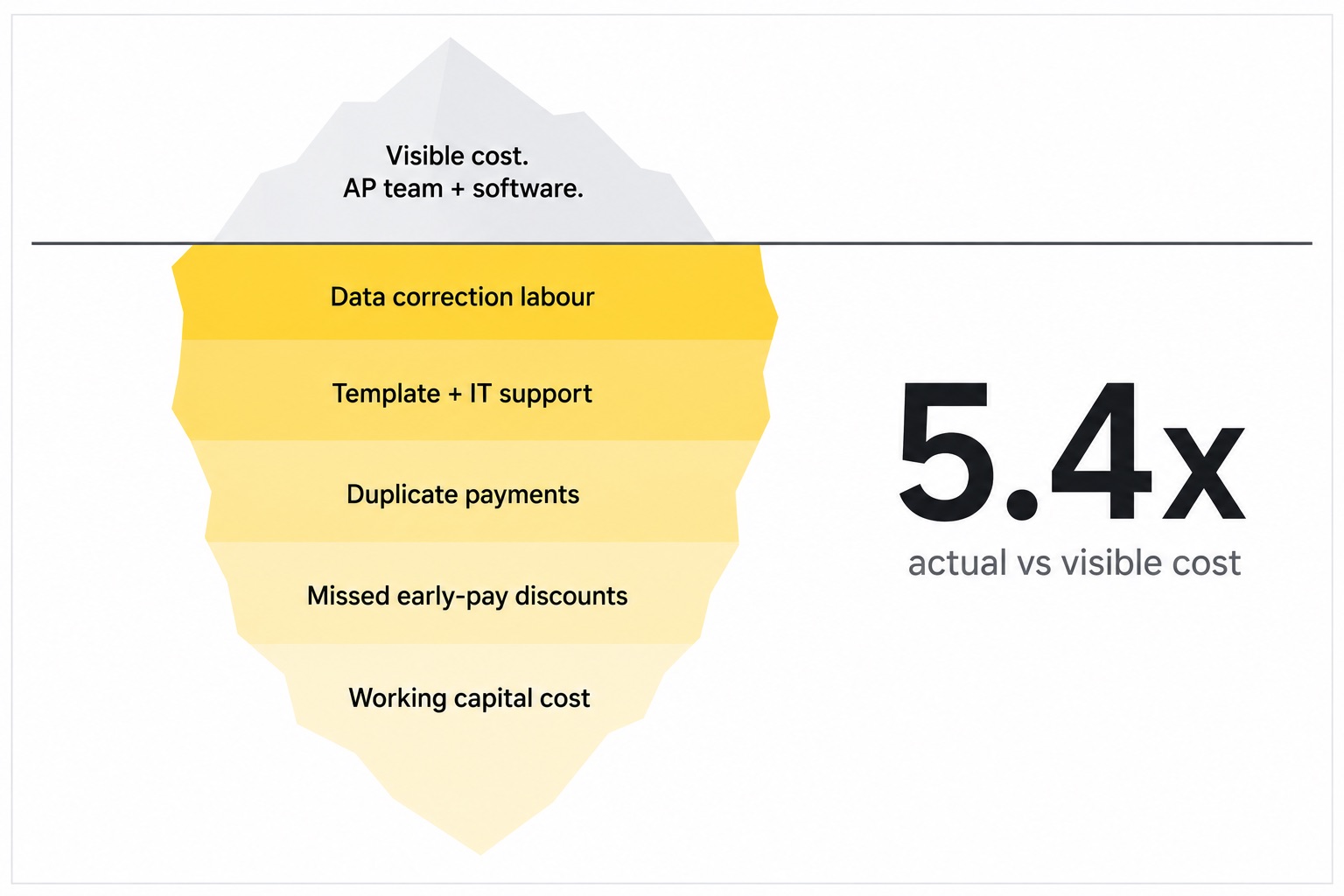
Most CFOs think they know what their accounts payable process costs.
They look at the headcount of the AP team. They look at the software licence. They add a bit for stationery and call it done. The number on the slide is usually 50 to 90 rupees per invoice.
The actual number is two to ten times higher.
The gap hides in places nobody is measuring. Duplicate payments that quietly post and quietly reconcile two months later. Early-payment discounts missed because the approval workflow took 11 days. Vendor relationships that strain because payments are late. Auditors flagging the same issue every year. The finance team working a Saturday to close the month.
None of these show up as a line item. They show up as a slow drag on everything finance touches.
Here are five signs your AP process is costing you more than you think. If you recognise three or more, the problem is not your team. The problem is your tooling.
Sign 1: Your team is still typing invoice fields into the ERP
This is the most common sign and the easiest to spot. Walk into your AP team's workspace at 4 PM on a weekday. If you see people looking at one screen with an invoice and typing into another screen with the ERP, the automation is broken.
It does not matter what software you bought. If a human is the integration layer between the invoice and the ledger, you have a digital data entry operation, not an automated AP function.
The most expensive version of this is the "OCR with human correction" setup. The OCR extracts fields with 75 to 85 percent accuracy. A human reviews every invoice to fix errors. The team is convinced this is faster than full manual entry. The accuracy data says otherwise. Correction-with-context takes longer per invoice than typing from scratch, because the human has to find the error before fixing it.
The fix is not better OCR. The fix is AI-Powered IDP that delivers 95 to 98 percent accuracy, validates fields against each other, and only escalates the genuinely uncertain extractions to a human.
Sign 2: Your OCR system needs a new template every few months
If your IT team has a recurring ticket called "Add template for Vendor X invoice format," your OCR investment is quietly costing you more than the licence fee suggests.
Template-based OCR has a hidden maintenance curve. Each new vendor format needs a template. Each format change at an existing vendor needs a template update. Some industries see 20 to 40 format changes per quarter across the vendor base.
Multiply that by the time it takes to build, test, and deploy a template. Add the cost of the AP staff who key in invoices manually while waiting for the template to be ready. Add the cost of the IT staff doing the template work.
The total template maintenance cost in many mid-size Indian enterprises is 15 to 30 lakh per year. This number is rarely measured because it sits in IT operations overhead, not in the AP cost line.
The fix is AI-Powered IDP that requires no templates at all. The model understands invoice structure across any vendor format on day one.
Sign 3: Duplicate payments are still showing up in audit findings
If your annual audit consistently flags duplicate payments, the problem is not your team's diligence. The problem is that your AP system cannot reliably match invoices against prior payments.
Duplicate payments happen because the same invoice arrives twice in slightly different forms. A vendor emails it. A site office couriers a hard copy. Someone in accounts uploads a third version after a follow-up call. The invoice number is the same but the metadata is slightly different. Manual or OCR-based systems struggle to match these because the data is not clean enough for an exact-match check.
Most Indian enterprises absorb 0.2 to 1.5 percent of their AP spend as duplicate payments. Some of it gets recovered eventually. Some of it does not. All of it costs money to investigate.
AI-Powered IDP fixes this because the structured output from extraction is consistent across document copies. The same invoice from the same vendor produces the same canonical data, so duplicate detection becomes a deterministic check rather than a probabilistic one.
Duplicate payment is not a discipline problem. It is a data problem. Clean data makes duplicates impossible to miss.
Sign 4: Vendors are calling to follow up on payments
When your vendors are routinely calling, emailing, or sending dunning letters to ask where their payment is, the AP process is failing in a way that costs more than money.
Vendor follow-ups are the visible symptom of a slow approval cycle. Invoices are sitting somewhere between receipt and payment for longer than the agreed terms. Either they have not been extracted yet, or they failed validation, or they are waiting for an approver who is travelling, or nobody knows they exist because they got stuck in someone's email.
The downstream cost is significant. Vendors price the relationship for risk. Your payment terms quietly get worse over time. Early-payment discounts that you could have captured disappear. New vendors hesitate to enrol. Critical vendors prioritise other customers during shortages.
For a manufacturing or BFSI enterprise, this shows up as 0.5 to 2 percent of total procurement spend in higher prices and lost discount opportunities. On a 100 crore AP base, that is 50 lakh to 2 crore per year.
AI-Powered IDP shortens the cycle by removing the extraction bottleneck. Invoices that used to take 3 days to enter the approval workflow now hit it within 4 hours of receipt. Vendor follow-ups drop sharply because invoices visibly move through the system.
Sign 5: Month-end close stretches because AP entries are not finalised
If your finance team consistently works the first weekend of every month to close the books, AP processing is almost always part of the bottleneck.
The pattern usually looks like this. Invoices receive throughout the month. Many of them sit unprocessed because of OCR errors, missing approvals, or unresolved exceptions. At month-end, the team has to scramble to capture them all so that accrual accounting reflects reality.
The scramble shows up as overtime, late posting errors, accrual reversals, and audit findings.
This is not a discipline issue. It is a throughput issue. When the document extraction layer is slow or unreliable, every downstream process stretches. The fix is upstream. Get extraction to 95 plus percent accuracy with cycle times measured in hours rather than days, and the month-end scramble disappears.
What the real cost number looks like
Here is the truth most CFOs miss. Cost per invoice is the wrong number to optimise. Total cost of AP per crore of spend is the right number.
The total cost includes the visible AP team and software, plus the hidden costs of duplicate payments, missed discounts, template maintenance, working capital tied up in unpaid invoices, audit overhead, and vendor relationship strain.
For mid-size Indian enterprises running manual or OCR-based AP, the total cost is 4 to 8 lakh per crore of AP spend annually. For enterprises running AI-Powered IDP with proper ERP integration, the same number is 1 to 2 lakh per crore.
The 3 to 6 lakh per crore difference is the leakage. It compounds every year. And it does not show up in any single line item, which is why most finance teams accept it as the cost of doing business.
It is not.
What changes when you fix the extraction layer
The single biggest lever in modernising AP is the document extraction layer. Get that right, and most of the downstream symptoms resolve. Get it wrong, and no amount of workflow optimisation, approval automation, or ERP customisation will fix the leakage.
This is why we built DocXtract as an API-first AI-Powered IDP platform. The integration replaces only the extraction layer. Your ERP, approval workflow, and payment runs do not change. The platform plugs into Oracle, SAP, Tally, Zoho, and custom-built systems through standard JSON endpoints.
What changes after the integration:
- Cost per invoice drops from 250-900 INR to 25-80 INR
- Extraction accuracy moves from 75-85 percent to 95-98 percent
- Average invoice-to-approval cycle compresses from 8-12 days to 2-4 days
- Duplicate payments drop to near zero with deterministic detection
- AP team transitions from data entry to exception handling, freeing capacity
- Month-end close compresses by 2 to 4 days
If you want the longer story on why we built DocXtract and what we learned in early production, the build story is here. We covered the AI versus OCR comparison in detail in this earlier post.
What to do this week
If you suspect your AP process is leaking, here is a practical sequence for the next 30 days.
- Calculate your true cost per invoice. Include all hidden costs, not just AP salary and software. The number will surprise you.
- Audit your top 5 vendors for payment timeliness. How often were they paid on the agreed terms last quarter? The gap is your relationship risk.
- Pull your duplicate payment data for the last 12 months. If you do not have this data, that is itself a finding.
- Measure your average invoice cycle time. From receipt in the AP inbox to approval in the ERP. If it is more than 5 days, the extraction layer is the bottleneck.
- Run a parallel test on AI-Powered IDP. Take 500 real invoices, including the ones that gave your current system trouble. Compare accuracy, cycle time, and validation outcomes.
The enterprises that fix this in 2026 will close their books faster, capture early-pay discounts, and operate with leaner AP teams. The ones that keep adding humans to fix OCR output will keep watching the same cost leak quietly drain their P&L.
The choice is not whether to automate. The choice is whether to automate in a way that actually works.
FAQ
What is the real cost of manual invoice processing?
The cost per invoice in fully manual AP processes ranges from 250 to 900 rupees per invoice in Indian enterprises, depending on volume and complexity. This includes data entry labour, error correction, duplicate payments, missed early-pay discounts, and the working capital impact of delayed approvals. AI-Powered IDP brings this down to 25 to 80 rupees per invoice.
How do I know if my AP automation is broken?
Five clear signs. Your team is still typing fields from invoices into the ERP. Your OCR system needs a new template every few months. Duplicate payments show up in audits. Vendors call to follow up on payments more than once a month. Month-end close stretches because AP entries are not finalised. Any one of these is a leakage indicator. Three or more means the automation is theatre, not function.
What is the difference between OCR and AI-Powered IDP for invoices?
OCR extracts text from invoice images, often using templates per vendor format. It breaks when vendors change layouts. AI-Powered IDP uses machine learning to understand invoices as documents, handles any format without templates, validates fields against each other, and learns from corrections. Production accuracy is 95 to 98 percent on AI-Powered IDP vs 75 to 85 percent on OCR.
What are common AP automation mistakes?
Buying OCR and calling it automation. Underestimating the maintenance cost of templates. Not measuring true cost per invoice. Treating exception handling as the bug instead of the feature. Choosing the cheapest tool instead of the one with the lowest total cost of ownership. Failing to integrate the tool with the ERP, so data moves through CSV exports instead of APIs.
How long does it take to fix a broken AP automation setup?
Replacing the document extraction layer with AI-Powered IDP typically takes 4 to 8 weeks for a mid-size enterprise. The integration replaces only the extraction component. Your ERP, approval workflow, and payment runs do not change. Most clients see measurable cost per invoice reduction within 90 days of switching.