
Why KYC Verification Quietly Breaks Every NBFC at Scale
Vinky Gola · · 11 min read · BFSI
Share: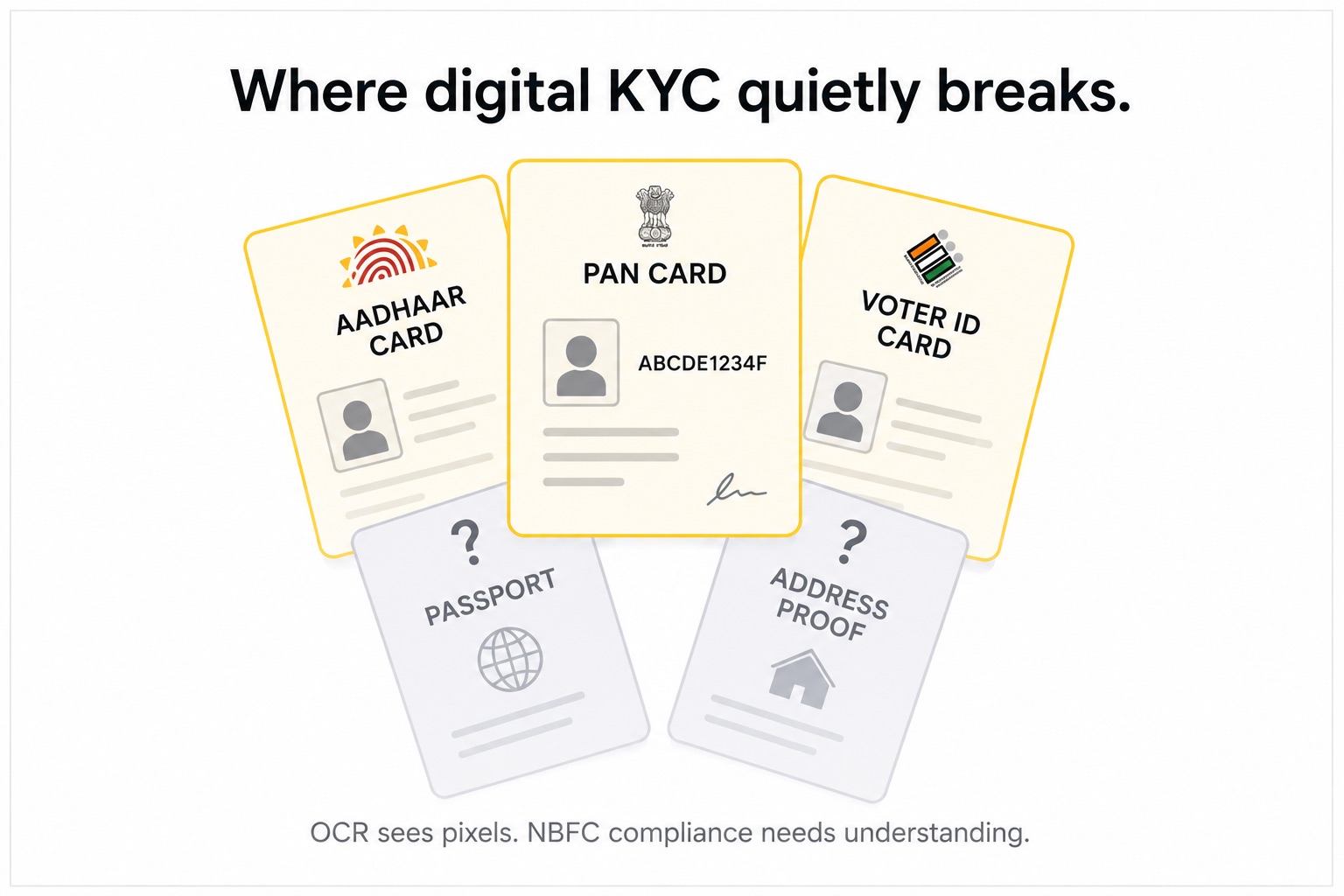
Every NBFC in India pitches "digital KYC, paperless onboarding, instant verification" on the homepage.
Walk into their operations floor and you will find a quiet team of 8 to 15 people doing one thing all day. Looking at scanned Aadhaar cards, PAN images, and address proofs that the system flagged as "low confidence." Fixing the data. Re-keying fields. Approving the customer manually.
The website says digital. The backend says diesel.
This is not a vendor problem. It is a category problem. Most NBFCs are running OCR with rules on top, calling it AI, and discovering at scale that OCR was never built for what KYC actually demands. The compliance team knows. The COO knows. Nobody wants to write the cheque to fix it because the demo on day one looked fine.
Let me walk through what actually breaks, why it breaks, and what AI-Powered IDP changes for NBFC KYC verification.
The KYC document pipeline NBFCs actually deal with
Before we talk about extraction technology, let me describe the documents that come in. Not the clean samples in the vendor pitch deck. The real ones.
An NBFC processing 5,000 KYC files a month receives a mix that looks roughly like this:
- Aadhaar e-KYC printouts with masked numbers, sometimes folded or stamped over
- Scanned PAN cards where the photo is faded and the signature overlaps the name
- Voter IDs in regional language scripts with English overlays
- Passport pages photographed at an angle on a customer's phone
- Address proofs that are utility bills, rent agreements, or bank statements, with handwritten amendments and stamps
- Director KYC packs from MSME borrowers, each containing six to ten documents
None of these come in a standard format. Resolutions vary. Languages vary. Lighting varies. The customer is on a phone in poor signal. The agent is in a tier 3 town with a flatbed scanner that has not been cleaned in two years.
This is the reality OCR was not built for.
Why traditional OCR fails on Indian ID documents
OCR has a single job. It converts pixels of text into machine readable characters. That is the entire scope.
It does not know what an Aadhaar number is. It does not know that a PAN follows the format AAAAA1111A. It does not know that a date on a voter ID is the date of birth, not the issue date. To make OCR useful for KYC, NBFCs add three things on top.
- Templates. One template per document type, sometimes per state, sometimes per issuing authority.
- Rules. "If you find 12 digits with spaces every 4, treat as Aadhaar. If you find AAAAA1111A pattern, treat as PAN."
- Human-in-the-loop reviewers. To fix what the templates and rules miss.
Each of these layers introduces operational cost that grows with volume. Templates need maintenance. Rules need exception handling. Humans need supervision and create their own error patterns.
The accuracy reality on real KYC documents:
Two things stand out. First, the best case is still 6 to 8 percentage points below the compliance threshold most NBFCs need. Second, the average across the document mix sits in the high 70s.
For a lender processing 5,000 KYC files a month, every percentage point below 98 translates to 50 files needing manual review per percentage point. Sitting at 80 percent means 900 files a month going through a human queue. That is your "digital KYC" promise becoming a 12 person operations team.
The website says digital. The backend says diesel.
What AI-Powered IDP changes for KYC verification
AI-Powered IDP is not better OCR. It is a different category of system.
OCR reads pixels. IDP reads documents. The shift matters because KYC verification is not a text extraction problem. It is a document understanding problem.
When a trained compliance officer reviews a KYC pack, they do not read left to right top to bottom. They scan for context. They check if the name on the Aadhaar matches the name on the PAN. They verify that the date of birth is consistent across documents. They notice that the address on the utility bill is the same as the one on the application form. They flag the file if the signature on the loan application looks nothing like the one on the PAN card.
AI-Powered IDP does the same thing. It uses large language models and vision transformers to process text, layout, and visual elements together. It understands document structure. It validates field relationships across documents. It scores its own confidence and flags only the documents that need a human eye.
The practical difference shows up in the operations floor. With AI-Powered IDP, your team stops being data correctors. They become exception handlers. The 90 plus percent of files that pass cross-validation flow straight through. The remaining 5 to 10 percent get flagged with the specific field and reason, so the human review is targeted, fast, and auditable.
The compliance angle nobody wants to talk about
RBI does not care which extraction technology you use. RBI cares that you can demonstrate the customer's identity was reliably established, that the verification trail is auditable, and that the records hold up six years later when an inspection happens.
Here is the uncomfortable truth about OCR-led KYC. The audit trail is weak. The system extracted a value. A human changed it. There is no record of why. There is no confidence score on the original extraction. There is no machine readable evidence of cross-validation.
When the RBI audit team asks for the verification logic that approved a borrower whose Aadhaar was 80 percent legible, the answer "our agent looked at it and was confident" is not a great place to be.
AI-Powered IDP changes the audit story because it gives you:
- A confidence score on every extracted field
- A timestamped record of cross-document validation outcomes
- An audit log showing what the AI flagged and what a human overrode
- Reproducibility, if you re-process the same document tomorrow you get the same result
This is not a nice-to-have. For NBFCs scaling past a few thousand loans a month, this is what the difference between a clean inspection and a problematic one looks like.
What we have seen building DocXtract for Indian financial documents
At RPATech, we built DocXtract because we kept watching the same pattern at every NBFC client. They had bought an OCR platform two years ago. It worked great in the proof of concept. It started breaking at month three of production. By month nine they had hired an operations team to fix the output. By year two they were quietly running a hybrid where the OCR ran first and humans cleaned up half of what came out.
The fix is not "buy a better OCR." OCR is a 1990s technology pretending to be modern. The fix is to replace the extraction layer entirely with AI-Powered IDP that was built for Indian documents from day one.
DocXtract handles Aadhaar, PAN, passport, voter ID, driving license, GST registration, and standard address proofs out of the box. We did not build templates for each. We trained models that understand what these documents are, what fields they carry, and how those fields validate against each other.
The numbers our clients see in production:
- 95 to 98 percent field-level accuracy across document types
- Cross-document name and DOB matching above 99 percent
- Average processing time under 3 seconds per document
- Straight-through processing on 88 to 92 percent of KYC packs
If you want the full story on why we built DocXtract and what we got wrong in the early versions, that write-up is here. The lessons translate directly from invoice extraction to KYC extraction because the underlying problem is the same. Indian documents are messier than the vendor pitch decks suggest, and only AI that understands them holds up at scale.
What NBFCs should actually do next
If you are an NBFC head of operations, compliance, or technology, here is the practical sequence.
- Audit your current KYC pipeline honestly. Not the demo numbers, the production numbers. How many files actually flow straight through? How many touch a human? What does that human team cost?
- Look at the field-level accuracy by document type. If you cannot pull this number, that is itself a finding. You cannot fix what you cannot measure.
- Run a parallel test. Take 500 real KYC packs that already cleared your current system. Run them through an AI-Powered IDP platform. Compare the extraction quality, cross-validation results, and processing time.
- Calculate the integration cost honestly. API-first platforms integrate in days, not months. The integration replaces only the extraction layer. Your loan origination system and compliance engine do not change.
- Make the call on operating cost. If your human review team is more than 3 percent of your monthly KYC volume, AI-Powered IDP pays for itself in under 6 months at NBFC pricing tiers.
The companies that figure this out in 2026 will scale lending without scaling their operations team. The ones that keep adding humans to fix OCR output will keep watching their cost per loan creep up while their digital KYC promise quietly turns into a manual back-office.
That is the choice. The technology has stopped being the question. The question is whether the leadership team has the appetite to admit that the OCR investment from 2022 is not what scales them through 2027.
FAQ
Why does KYC verification fail at scale in Indian NBFCs?
Most NBFCs use OCR for KYC document extraction. OCR reads pixels into characters but does not understand what an Aadhaar card, PAN card, or address proof actually is. The moment documents deviate from clean printed formats, accuracy drops below 80 percent. NBFCs then add human reviewers to fix errors, which defeats the purpose of digital KYC.
What is the difference between OCR and AI-Powered IDP for KYC?
OCR extracts text from images. AI-Powered IDP, or Intelligent Document Processing, understands document structure, validates field relationships, cross-checks data across documents, and handles variations in format, language, and quality. For KYC, this means a single platform handles Aadhaar, PAN, passport, voter ID, and address proofs without separate templates.
What accuracy rate is acceptable for KYC document extraction?
For NBFC KYC compliance, you need 98 percent plus field-level accuracy to enable straight-through processing. Anything below that creates a human-in-the-loop bottleneck that makes digital KYC slower than manual verification in practice.
Does RBI accept AI-based KYC verification?
RBI does not specify the extraction technology, but it requires verifiable accuracy, audit trails, and the ability to demonstrate that customer identity was reliably established. AI-Powered IDP solutions that maintain confidence scores, audit logs, and document validation history satisfy these requirements better than rule-based OCR.
How long does it take to integrate AI-Powered IDP into an existing KYC workflow?
API-first solutions like DocXtract integrate in days, not months. The integration replaces only the document extraction layer of your existing KYC workflow. Your loan origination system, compliance engine, and customer onboarding flow remain unchanged. The output is structured JSON that flows directly into your existing pipeline.