
Financial Document Intelligence in Retail Lending
Sibani Sekhar Sahoo · · 8 min read · BFSI
Share: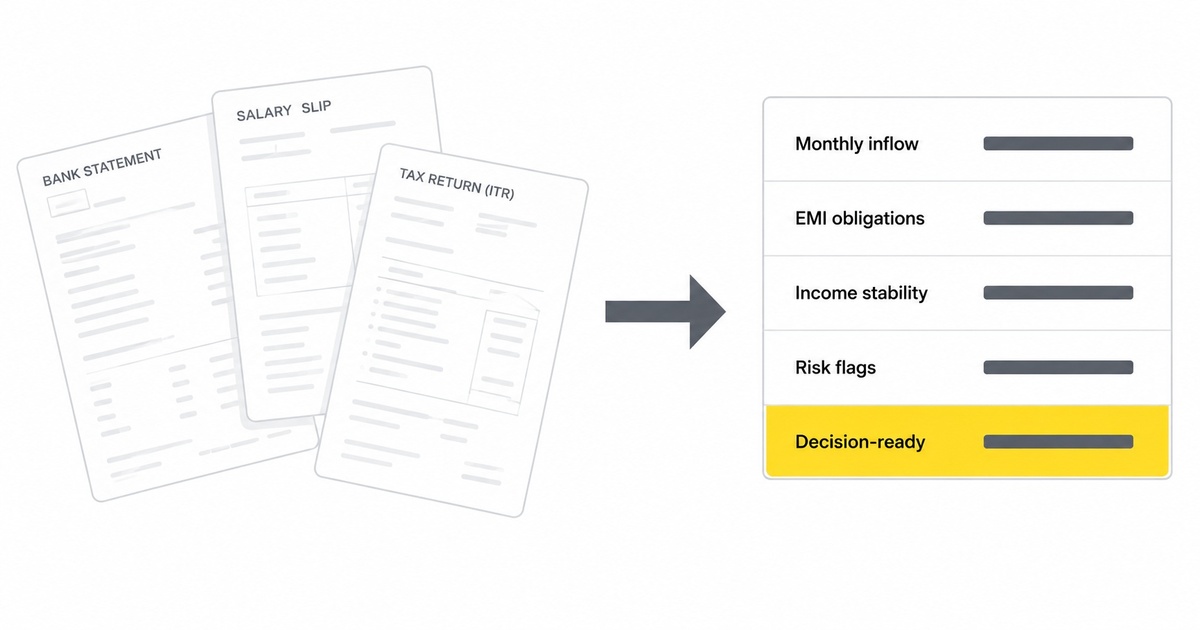
The future of lending belongs to institutions that can convert unstructured financial documents into underwriting intelligence. Not faster forms. Not slicker apps. The institutions that win the next decade of retail credit will be the ones that turn a borrower's pile of bank statements, salary slips and tax returns into a credit decision before a competitor has finished opening the files.
This is a quieter shift than the headlines about AI credit scoring suggest. The models get the attention. But a credit model is only as good as the data fed into it, and in retail lending that data still arrives as documents. Messy, inconsistent, human documents. The lenders pulling ahead are the ones who have solved the layer that sits between the document and the model.
That layer has a name now: financial document intelligence. Here is why it has become the dividing line in retail lending, and what it actually involves.
The front end is digital. The middle is not.
Most retail lenders have spent the last few years digitising the borrower-facing experience. There is an app. There is a loan origination system. There is a CRM. Applications come in cleanly through a digital funnel.
Then the application reaches underwriting, and the digital story stops. A credit analyst downloads the borrower's bank statement PDF, opens a spreadsheet, and starts copying figures. Salary credits, EMI debits, average balance, bounce instances. The same analyst opens the ITR, the salary slips, the GST returns, and does it again. The modern front end hands off to a manual middle.
This is where the cost and the delay actually live. Not in the application. In the underwriting middle, where a digital pipeline narrows to the speed of a person reading documents and typing numbers.
Why documents are the hard part
It is tempting to think document handling is a solved problem. Optical character recognition has existed for decades. But reading retail credit documents at scale is genuinely hard, for reasons that compound.
Bank statements are the clearest example. A lender serving a real borrower base receives statements from hundreds of banks: national banks, regional lenders, cooperative banks, payment banks. Each formats its statement differently. Transaction descriptions follow no standard. The same salary credit might read as "SALARY", "SAL CR", "NEFT-EMPLOYER NAME" or a cryptic reference code depending on the bank. Add scanned copies, mobile photographs, password-protected PDFs and regional-language headers, and the variety is effectively unbounded.
Then multiply across document types. ITRs and Form 16 for income verification. GST returns for self-employed and SME borrowers. Salary slips in every employer's template. Each type carries critical underwriting signal, and each arrives in its own chaos of formats.
The borrower does not send you data. The borrower sends you documents. The work of lending is turning one into the other, and most institutions still do it by hand.
From extraction to intelligence
It helps to separate two things that often get blurred. Reading a document is not the same as understanding it.
Basic extraction pulls text off a page. That is necessary but not sufficient. Financial document intelligence goes further: it understands what the document is, locates the fields that matter, validates them against each other, and converts them into the specific signals an underwriter needs. Not "here is the text on this bank statement" but "here is the average monthly inflow, here are the recurring EMI obligations, here is the income consistency over six months, and here are the three transactions that need a human eye."
That progression, from pixels to text to structured fields to underwriting signal, is the whole game. The lenders winning on speed and quality have automated the entire chain, not just the first step.
What changes when you automate the document layer
The effects are not subtle, and they show up in the metrics lenders actually care about.
Turnaround collapses
When documents are read and structured the moment they arrive, the manual data-preparation step disappears from the critical path. Underwriting turnaround that ran in days starts running in hours, because the analyst opens a file that is already structured rather than a stack of PDFs to be keyed.
Capacity stops being headcount
In a manual process, more applications mean more analysts. Automating the document layer breaks that link. The same credit team can process far higher volumes, because their time goes to decisions and exceptions rather than data entry. Growth no longer requires proportional hiring.
Decisions get better, not just faster
Manual data entry introduces errors, and in credit those errors are expensive. A misread figure can mean a wrong decision in either direction: a good borrower declined or a risky one approved. Consistent, validated extraction means the credit model and the analyst are working from accurate data every time, which improves decision quality alongside speed.
The thin-file borrower becomes serviceable
Much of the next wave of retail credit growth is in borrowers without a clean salaried history: self-employed individuals, gig workers, small business owners. Their creditworthiness lives in documents that are harder to read, GST returns, irregular bank statements, mixed income sources. A lender that can extract intelligence from these documents can serve borrowers that a manual process would reject or take too long to assess.
The capability, not the feature
It would be easy to read all this as an argument for buying a bank-statement-analysis tool. It is not. A point tool that reads one document type is a feature. Financial document intelligence is a capability, and the distinction matters.
A capability handles every document type that feeds a credit decision, not just bank statements. It handles new formats without someone building a template each time. It validates across documents, so the income on the salary slip can be checked against the credits on the bank statement. It feeds the loan origination system through an API, so the structured data lands where the decision is made. And it does all of this consistently enough that the institution can build its underwriting process around it.
That is the line the leading lenders have crossed. They have stopped treating document handling as a clerical task to be staffed and started treating it as an intelligence layer to be engineered. The borrower still sends documents. But inside the institution, those documents become decision-ready data the moment they arrive.
The future of lending belongs to the institutions that make that conversion their core competence. Everyone else will be reading PDFs by hand while their competitors have already decided.